Remembering Tim Slessor
4.46-50
4.46-50
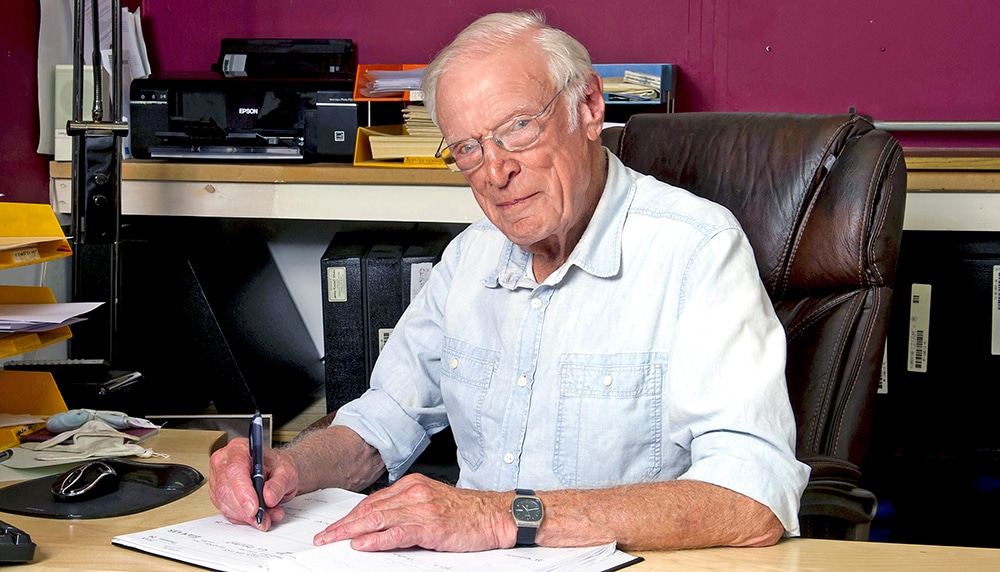
Adventurer and producer who went on the 1955 Oxford and Cambridge expedition and was a cornerstone of the BBC’s golden age of travel, dies aged 94.
Tim Slessor was a 23-year-old student when he and a group of friends hatched a plan over a late-night coffee to drive from London to Singapore, a route that had not previously been completed. “We went because, if I may coin a cliché, we wanted to,” he wrote in the preface to First Overland: London to Singapore by Land Rover (1957), his account of the journey, variously described as between 15,000 and 20,000 miles, which remains in print today having inspired generations of adventurers to hit the road.
The Oxford and Cambridge Far Eastern Expedition, as they described themselves, travelled in two Land Rovers painted dark and light blue, for Oxford and Cambridge respectively. Besides Slessor the group included Adrian Cowell, Patrick Murphy, Henry Nott, Nigel Newbery (the sole Oxford participant) and Antony Barrington Brown, the photographer who in 1953 had captured images of Francis Crick and James Watson with their model of the DNA double helix.
They spent the summer of 1955 completing their exams, begging for sponsorship, seeking permissions, collecting more than 50 maps and working out a route. “On September 1, after five months of preparation, we moved the still-unpacked kit off the seats, climbed into our cars, said our goodbyes and pulled away from Hyde Park Corner,” Slessor wrote. First, they called into the Grenadier pub in Belgravia for a scotch egg and a swift pint “for the road”.
From France they drove into Germany, Austria and Yugoslavia, where their red fire extinguishers were mistaken for weapons by the police in Belgrade. “After explanations, however, we exchanged the customary cigarettes and then moved on with their good wishes,” Slessor wrote. They continued through Greece and Turkey, drove across the Syrian desert alongside a 700-mile oil pipeline and entered Baghdad, where their cars were overhauled and checked, before arriving in Tehran.
At the Indian frontier the authorities were disturbed by two jerry cans on the Oxford vehicle that were boldly labelled “gin” and “tonic” in red paint. “India was in the throes of impending prohibition, and for us to enter with what purported to be four and a half gallons of gin was obviously asking too much. ‘If water, then why you put gin?’ they asked, reasonably enough. We were clearly bootleggers,” he said. By now, filling stations were becoming fewer and further apart.
They examined irrigation systems in Pakistan, investigated concerns that Kashmiri bagpipe manufacturers were undermining the Scottish industry, spent Christmas as guests of Brooke Bond tea in Calcutta and hacked through the overgrown Stilwell Road in the Burmese jungle, built by the US military during the Second World War, covering ground untraced since fighting ceased in 1945. “Hardly had we stepped from our cars when we were signed up by the ruling family for the annual cricket match,” he wrote, though the occasion was “remembered for its social rather than its sporting prowess”.
While parts of Burma were “an earthly, even heavenly, Shangri-La”, our heroes were disappointed not to be kidnapped. They had heard how well a couple of World Health Organisation doctors were treated by bandits and thought it would make for a gripping story. A police escort accompanied them to the Thai border where their “extraordinary run of luck” now turned into a series of crashes and spins on slippery roads, while the highways of Malaya were “the best roads since Germany”.
Finally they entered Singapore, where a champagne reception awaited them at Champion Motors, the Land Rover showroom on Orchard Road. After recuperating they returned by ship to Calcutta before driving back to London over much the same route. Speaking to The Times many years later, Slessor said: “Before we set out, the experts had told us that we were geographically ignorant and politically naive; the journey couldn’t be done. All that did was to make us more determined.”
Before leaving they were given a hand-cranked cine camera, rolls of film and a vague promise of a documentary series by a young BBC producer called David Attenborough. On their return he came through, helping Slessor and his colleagues to turn their footage into three short Travellers’ Tales films. They were shown on BBC Television with Attenborough later writing that “both the journey and its telling have long been regarded as classics”.
In 2005 Attenborough told a BBC tribute to mark the 50th anniversary of the expedition that it was “a journey that I don’t think could be made again today”. Slessor was not so sure. In 2019, aged 87, he was among a team determined to repeat the expedition in reverse using the same vehicle, which had been found in St Helena, its gin and tonic jerry cans still intact, and which had been restored by “this marvellous, eccentric Yorkshireman”.
When the time came, Slessor was unfortunately unwell and was replaced by his grandson, Nat George. Never one to miss an opportunity, he took part in the ensuing TV series, Last Overland: Singapore to London, where in one early scene he is seen tutoring Alex Bescoby, the expedition leader, in driving the old Land Rover and showing him the art of double-declutching, the old-school method for changing gears. “Are you listening, Jeremy Clarkson,” the octogenarian bellowed to the camera. “This is motoring.”
Timothy Paul Slessor was born into a family of German-Jewish descent in Gosport, Hampshire, in 1931, the only child of Lieutenant Commander Evelyn Slessor, an officer in the Fleet Air Arm, and his Australian wife Hope (née King) whose grandfather, according to family folklore, had been involved in apprehending the outlaw Ned Kelly. He spent much of his early life in Malta, home of the Royal Navy’s Mediterranean fleet.
His father was among more than 1,500 sailors who perished when German submarines picked off HMS Glorious and two other ships during the Norwegian campaign in June 1940. It was one of several establishment cover-ups that Slessor later investigated in his book Lying in State: How Whitehall Denies, Dissembles and Deceives, from the Chinook Crash to the Kelly Affair (2004), which involved digging deep into official and unofficial files, and tapping sources inside and outside Whitehall.
Accompanying his mother to her homeland, he was educated at Geelong Grammar School, Victoria, but for his postwar return journey to Britain he was sent ahead by ship with a company of Royal Marines. A naval widows’ fund provided for his education at Malvern College after which, inspired by his former shipmates, he elected for National Service with the Commandos. Commissioned from the ranks, he saw active service in Malaya where he shared a bivouac with Jeremy Moore, the future commander of land forces in the Falklands conflict. “In the jungle, one grows up quickly,” he observed enigmatically.
He read geography on a scholarship at St Catharine’s College, Cambridge. After the First Overland expedition he joined BBC Radio before moving to television. In 1959 he married Janet Franklin, whom he had met while briefly working in BBC Schools Radio, where she was a secretary. Janet predeceased him and he is survived by their children, Jeremy, who designs and builds golf courses, and Katy, who works in television.
Obituary taken from The Times, 27th May 2026